
There is something different about this year’s International Week of Deaf People.
It is not simply about awareness. It is not simply about celebrating Deaf culture or learning a few signs for a week. The 2026 theme, “Declaring Deaf People’s Human Rights,” asks us to look more closely at what those rights mean in everyday life, particularly in countries like Cameroon.
International Week of Deaf People runs from 21 to 27 September 2026, with each day focusing on a different aspect of Deaf people’s rights, including national sign languages, inclusive education, accessibility, participation, Deaf culture and human rights. This year also marks the 75th anniversary of the World Federation of the Deaf, founded in 1951.
And honestly, the theme raises a bigger question for countries like Cameroon:
What does it actually mean for Deaf people to have rights if they cannot fully access the systems through which those rights are exercised?
Because having a right on paper and being able to use that right are not always the same thing.
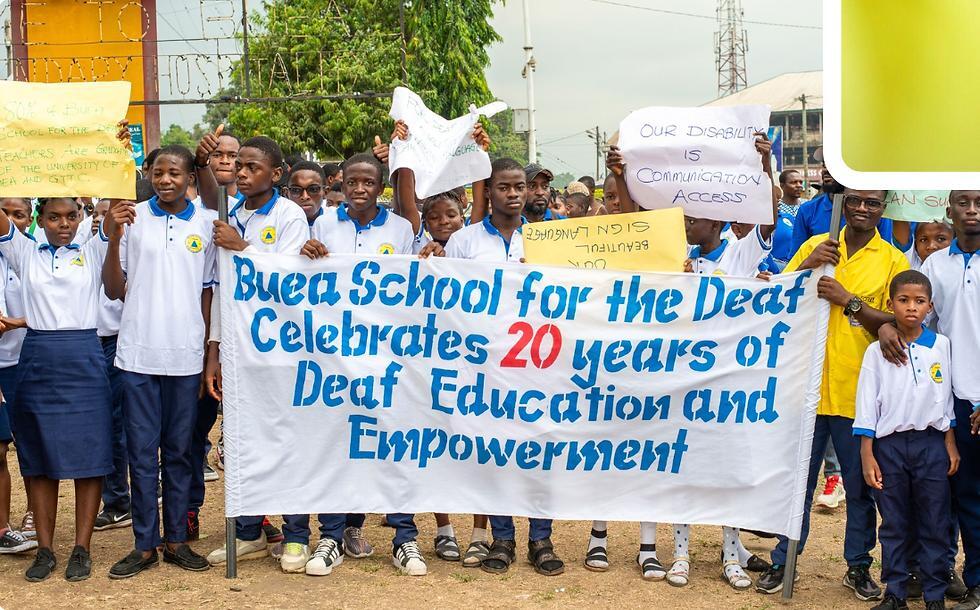
International Week of Deaf People is an opportunity to celebrate Deaf people, while also asking whether our communities provide the access they need to participate fully.
The numbers tell part of the story
Hearing loss is not a small or distant issue.
According to the World Health Organization, more than 1.5 billion people globally live with some degree of hearing loss, while around 430 million people have disabling hearing loss that requires rehabilitation. By 2050, WHO projects that more than 700 million people could have disabling hearing loss.
WHO also estimates that approximately 95.1 million children between the ages of 5 and 19 live with hearing loss. The burden is particularly significant in low and middle-income countries.
Cameroon is part of that picture.
WHO’s country profile for Cameroon estimates the prevalence of disabling hearing loss at 1.8%. The same profile reports that Cameroon had no national newborn and infant hearing screening programme, no school hearing screening programme and no reported provision of hearing aids and implants within the health-system capacity assessed in that report.
These numbers are important.
But they are not the whole story.
Deaf people are not simply a healthcare statistic.
Deaf communities are also linguistic and cultural communities.
And that is exactly why this year’s theme matters.
Deafness is not only about hearing
When we talk about deafness, the conversation can very quickly become centred around fixing hearing.
Hearing tests.
Hearing aids.
Medical interventions.
Rehabilitation.
All of these can be important. But they do not answer every question.
What happens when a Deaf child enters a classroom where the language being used is inaccessible to them?
What happens when a person goes to a hospital and there is no sign language interpreter?
What happens when important government information is delivered only through spoken announcements?
What happens when a job interview, public service, television programme, website or emergency announcement does not consider Deaf people?
At that point, the issue is no longer simply whether someone can hear.
It is whether the environment allows them to participate.
That distinction is important.
The WFD’s 2026 themes place national sign languages at the centre of Deaf people’s human rights. The organisation’s position is that access to education, public services, information and participation cannot be fully achieved without access to national sign languages.
So, when we talk about inclusion, perhaps we should ask a more practical question:
Can a Deaf person actually access the same opportunities as everyone else?
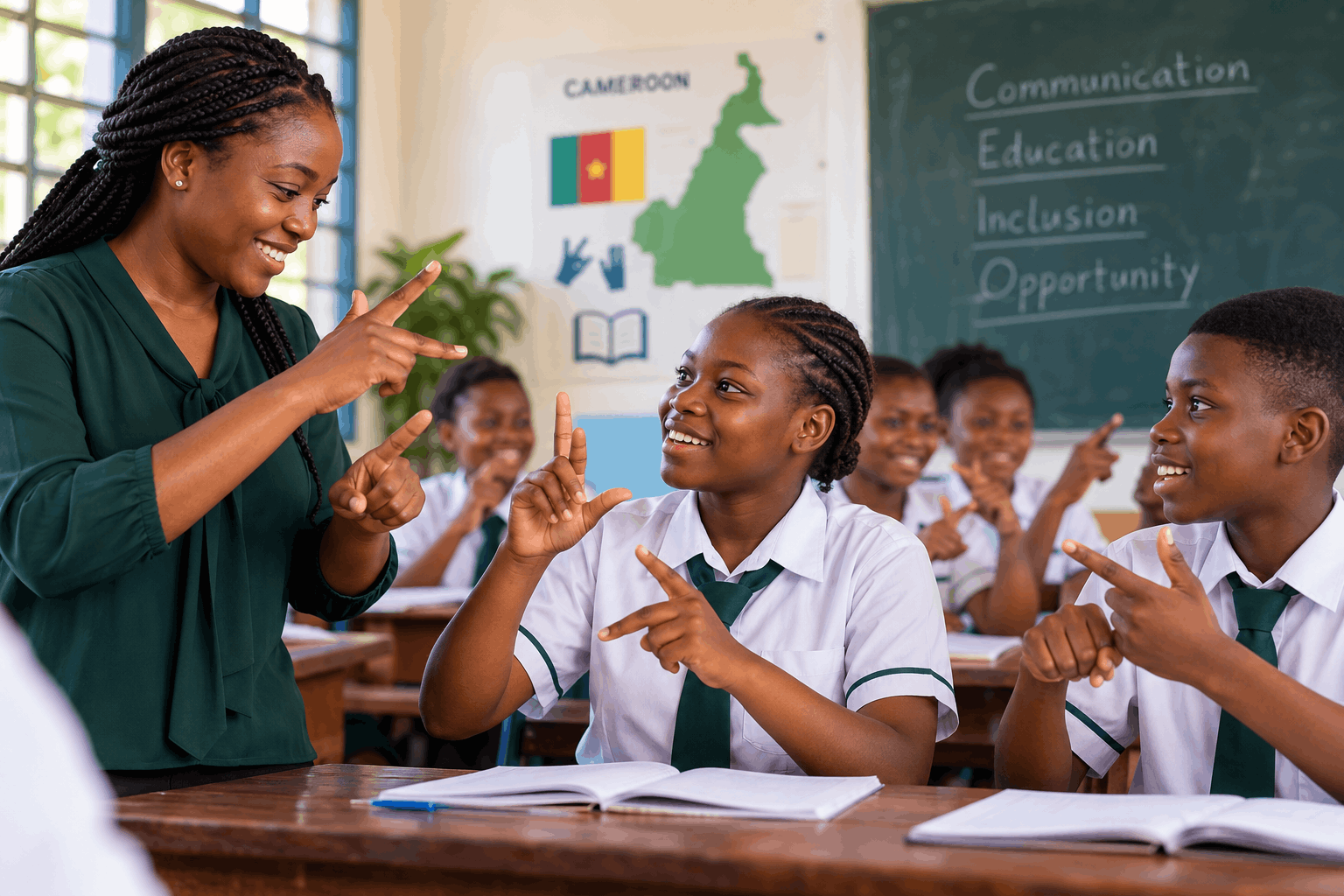
Education is one of the places where language access can determine whether inclusion is meaningful or simply exists on paper.
Think about education for a moment
Education is one of the clearest places where these barriers become visible.
The WFD has dedicated one of the 2026 themes specifically to “The Right to a Quality Multilingual Inclusive Education.” For Deaf learners, the organisation highlights access to education in national sign languages as essential to development, identity and inclusion.
Cameroon has made progress in its broader approach to inclusive education.
UNICEF reports that in 2024, the Government of Cameroon validated an inclusive education package for children with disabilities. UNICEF also notes that children with disabilities continue to face barriers including inadequate infrastructure and a shortage of trained staff able to support their learning.
There are also examples of practical interventions.
In the North-West and South-West regions, UNICEF and partners have screened more than 3,000 children in schools and temporary learning spaces to identify disabilities and determine the support they need. More than 82 teachers and facilitators have received training that includes inclusive education practices, basic Braille and sign language.
That is meaningful progress.
But it also tells us something else.
There is still a gap to close.
Training 82 teachers is meaningful. But how many more teachers need this training?
Screening 3,000 children is meaningful. But how many children remain unidentified?
And beyond identification, how many Deaf children have consistent access to teachers who can communicate with them in sign language?
How many schools have the resources to support them?
How many families have access to information about Deaf education early enough to make informed choices?
These are the questions that move us beyond awareness.
Cameroon has made commitments. The question is implementation.
Cameroon is not starting from zero.
The country has a national legal framework for the protection and promotion of persons with disabilities through Law No. 2010/002 of 13 April 2010. The law specifically includes sensory disabilities, including deafness and hearing impairment, within its framework.
Cameroon also signed the Convention on the Rights of Persons with Disabilities (CRPD) in 2008 and ratified it on 28 September 2023, with the Convention entering into force for Cameroon on 28 October 2023.
That matters because the CRPD is built around a rights-based approach to disability.
It is about participation.
It is about accessibility.
It is about equality.
It is about the right to education.
It is about the right to information and communication.
And it is about ensuring that persons with disabilities are able to participate in decisions that affect them.
But rights become meaningful through implementation.
That is where the conversation around Deaf people becomes particularly important.
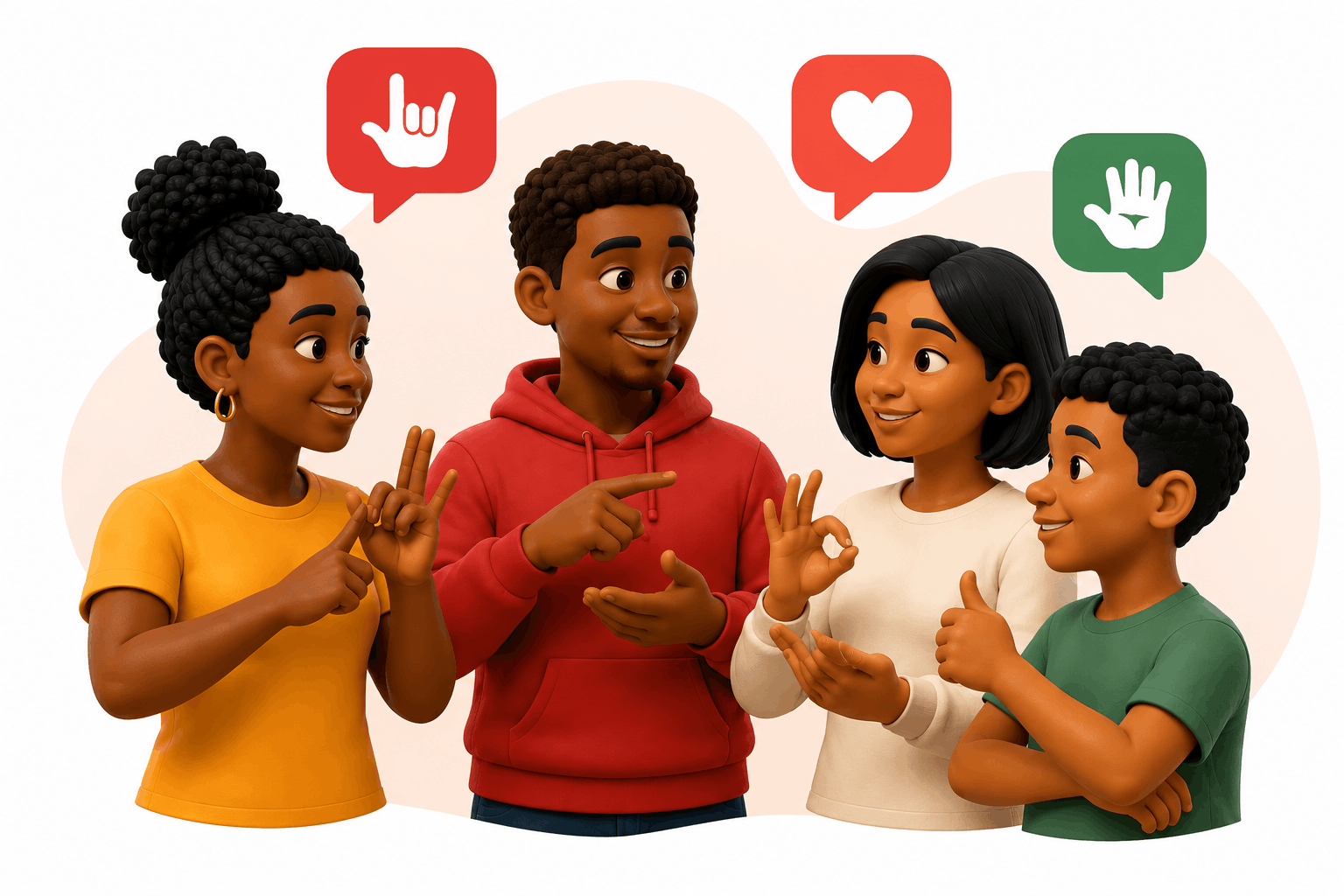
For Deaf communities, language access is closely connected to access to information, education and participation.
Accessibility is more than a ramp
When we hear the word accessibility, we often think about physical spaces.
Ramps.
Elevators.
Accessible toilets.
But accessibility also has a language.
A person can walk into a building that is physically accessible and still be unable to access the service inside.
Imagine going to a hospital where nobody can communicate with you.
Imagine standing in a government office while important information is explained verbally.
Imagine trying to follow an emergency announcement that is delivered only through sound.
Imagine applying for a job when the interview process has no provision for your communication needs.
That is an accessibility problem.
And it is why the WFD’s Thursday theme, “No Access Without National Sign Language,” is so important. The WFD connects accessibility under Article 9 of the CRPD with the availability of national sign language services and inclusive communication.
Accessibility is not only about getting through the door.
It is also about being able to understand what happens once you are inside.
“Nothing About Us Without Us”
Perhaps one of the most important themes of the week is Friday’s:
“Nothing About Us Without Us.”
The WFD connects this principle to Articles 4.3 and 33 of the CRPD and emphasises that Deaf people should be at the centre of decisions that affect their lives.
And I think this is something we should pay much more attention to in Cameroon.
It is easy to design a programme for a community.
It is harder, and much more meaningful, to design it with the community.
If we are developing education policies for Deaf children, Deaf people should be part of those conversations.
If we are developing accessibility standards, Deaf people should be consulted.
If we are deciding how public information should be communicated, Deaf people should have a voice.
If we are creating technology intended to improve accessibility, Deaf users should be involved in designing and testing it.
This is not simply about representation for the sake of representation.
It is about better solutions.
The people experiencing the barriers are often the people who can explain them most clearly.
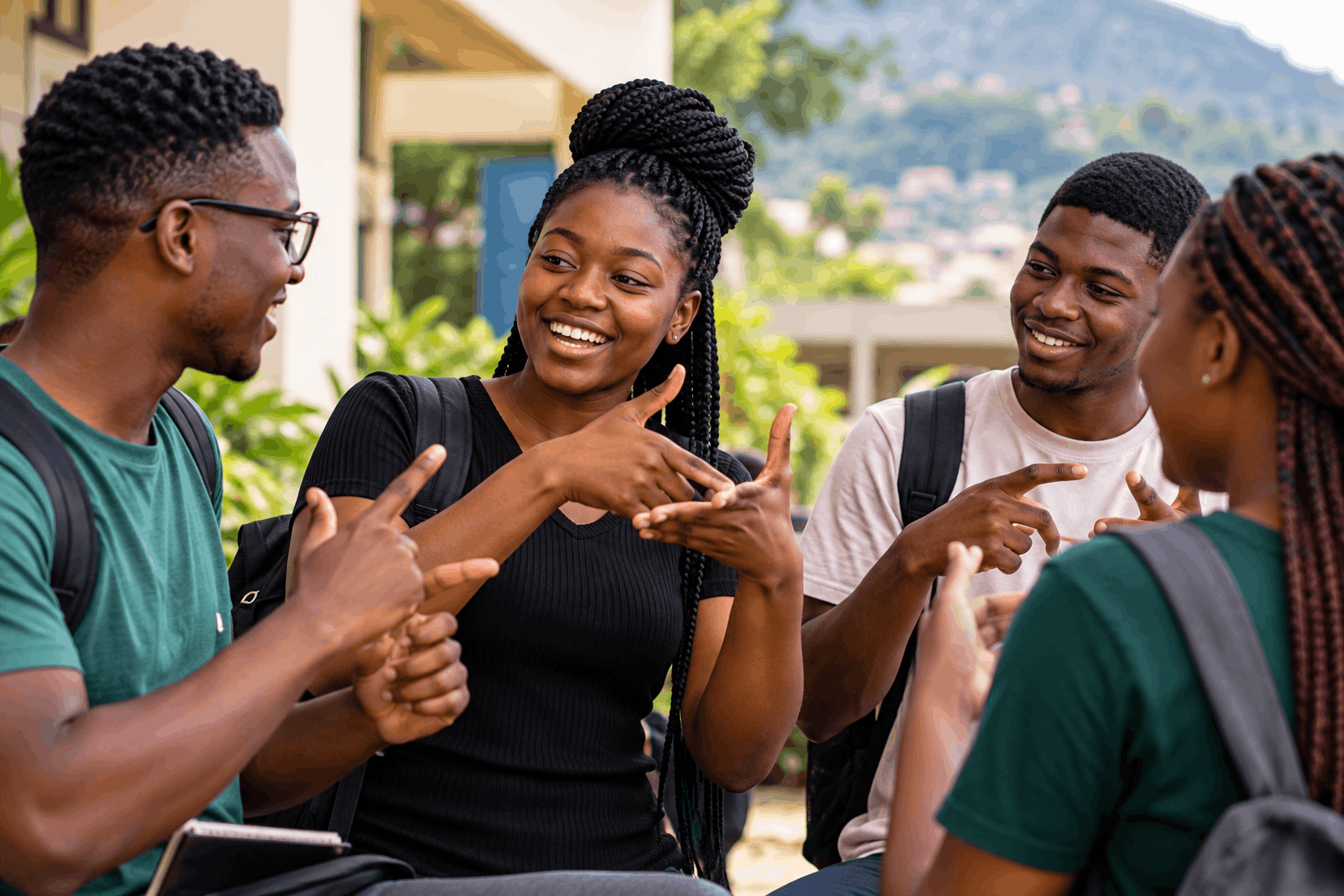
Inclusion is stronger when Deaf people are not simply represented in conversations, but are part of shaping them.
Deaf culture is part of the conversation
Another important part of this year’s theme is culture.
The WFD’s Saturday theme is “Deaf Culture Is a Human Right.” It describes Deaf people as members of vibrant linguistic and cultural communities and connects the protection of Deaf culture and identity with Article 30 of the CRPD.
This is important because the conversation about Deafness can sometimes focus entirely on what a person cannot hear.
But Deaf people also have languages, histories, communities, identities and cultures.
Sign language is part of that.
Community is part of that.
Deaf-led organisations are part of that.
The stories and experiences of Deaf people are part of that.
And when we talk about inclusion, we should not be asking only:
How do we make Deaf people fit into existing systems?
We should also be asking:
How do we make our systems capable of including different ways of communicating, learning and participating?
That is a much bigger conversation.
So, what should International Week of Deaf People mean for Cameroon?
It should certainly be a celebration.
We should celebrate Deaf people.
We should celebrate Deaf culture.
We should celebrate sign language.
We should celebrate the achievements of Deaf Cameroonians.
But celebration should not be where the conversation ends.
It should be where it starts.
This week gives us an opportunity to ask some uncomfortable but necessary questions.
Can a Deaf child in Cameroon access quality education in a language they understand?
Can a Deaf person access healthcare without depending entirely on a family member to interpret?
Can Deaf people access government information independently?
Can they participate equally in employment and public life?
Are our digital platforms accessible?
Are our media organisations providing information in formats that Deaf audiences can actually access?
And perhaps most importantly:
Are we asking Deaf people what inclusion looks like to them?
Because inclusion should not be something we define for people.
It should be something we build with them.
From awareness to action
The theme of International Week of Deaf People 2026 is ambitious because it asks us to think beyond sympathy.
It asks us to think about rights.
The right to language.
The right to education.
The right to information.
The right to participate.
The right to culture.
The right to make decisions about one’s own life.
These are not special privileges.
They are human rights.
For Cameroon, the challenge is therefore not simply to recognise Deaf people during one week every September.
It is to consider what happens on 28 September.
After the hashtags disappear.
After the awareness campaigns end.
After the celebrations are over.
Do we go back to business as usual?
Or do we take what this week has reminded us of and begin making our schools, hospitals, workplaces, media, technology and public institutions more accessible?
Because ultimately, declaring Deaf people’s human rights is only the beginning.
The real work is making those rights visible in everyday life.
And perhaps that is what International Week of Deaf People should leave us with this year:
Don’t just celebrate Deaf people. Listen to what they are asking for, and make room for them to lead the conversation.
Sources
World Federation of the Deaf. International Week of Deaf People 2026: Declaring Deaf People’s Human Rights. The source for the 2026 theme, dates and daily themes.
World Health Organization. Deafness and hearing loss, 3 March 2026. Global figures on hearing loss, disability and projected trends.
World Health Organization. Status Report on Ear and Hearing Care: Cameroon country profile. Data on the estimated prevalence of disabling hearing loss and national hearing-care capacity.
UNICEF Cameroon. Education. Information on inclusive education and barriers faced by children with disabilities in Cameroon.
United Nations Treaty Collection. Cameroon’s ratification of the Convention on the Rights of Persons with Disabilities in September 2023.
International Labour Organization, NATLEX. Cameroon Law No. 2010/002 of 13 April 2010 on the protection and promotion of persons with disabilities.